Land, Food & Future: Episode 1
Can Irish wine become more than a curiosity?
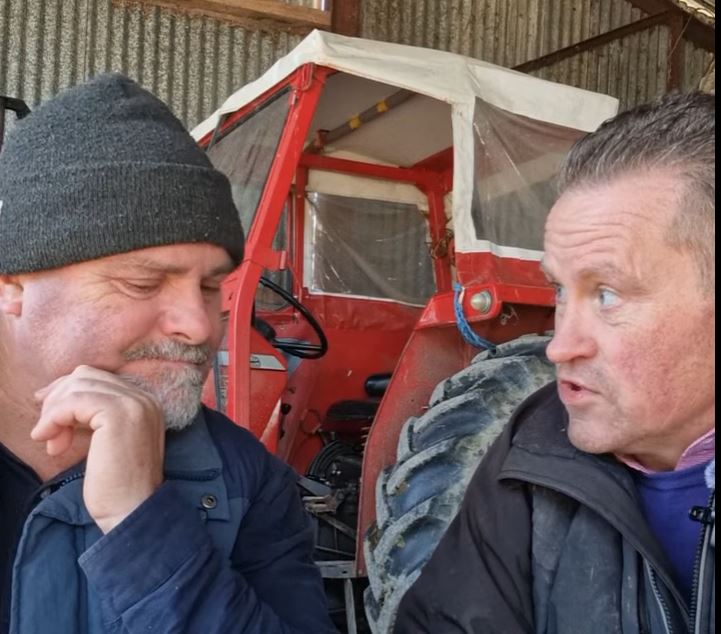
That was the opening question when I sat down with David Llewellyn of Lusca Vineyard for the first episode of Land, Food & Future, our new series of conversations about Irish farming, food, drink and rural life.
For Nicola and me, this is a practical question. As we develop our vineyard at Ballyclery in County Offaly, we are investing time, money and considerable energy in discovering what we can grow and what those grapes might become.
David has spent decades exploring those questions. His answer is encouraging, but comes with qualifications that anyone interested in growing grapes in Ireland should hear.
Good Irish wine is possible. Producing it consistently, and building a viable business around it, requires much more than enthusiasm.
Watch the full Land, Food & Future interview with David Llewellyn on YouTube.
From a German winery to growing grapes in Ireland
David’s interest began while working in a winery in Germany around 40 years ago. The experience planted a question in his mind: could something similar be done back home?
On returning to Ireland, he researched the subject and discovered that a small number of people were already experimenting with vines. He began sourcing potentially suitable grape varieties and planting trials of his own.
The reaction included fascination, curiosity and some ridicule. But David enjoyed the challenge of attempting something others thought impossible.
What followed was a long process of experimentation and observation. That accumulated experience is particularly valuable to people like us, who are at a much earlier stage.
We previously introduced David and his work in our Journal profile of Lusca Vineyard. This conversation gave us the opportunity to explore the lessons behind that story.
Ireland’s wine challenge is about ripening grapes
It is easy to assume that Ireland’s biggest problem for wine production must be rain.
David’s emphasis is different. In his experience, the central constraint is getting sufficient warmth during the growing season for grapes to ripen reliably.
He points out that some established wine regions receive more rainfall than parts of Ireland. For Irish growers, the crucial question is whether a particular grape variety can complete its ripening process within the heat available during our summers.
That also explains his caution about comparisons with England. Success across the Irish Sea does not automatically establish that the same varieties will perform equally well here.
I admitted during the interview that I have occasionally made the patriotic argument that if the English can do it, surely the Irish can too.
David’s response is a useful reminder: confidence needs to be supported by evidence from the vineyard.
Which grape varieties can succeed in Ireland?
David is particularly positive about Rondo, a dark-skinned grape used for red wine, which he says has ripened consistently and produced wines he enjoys. He also discusses Solaris among the varieties with an established place in cooler growing regions.
New grape varieties offer further possibilities. However, he draws a distinction between a promising trial and enough evidence to justify planting at scale.
That distinction matters enormously to us.
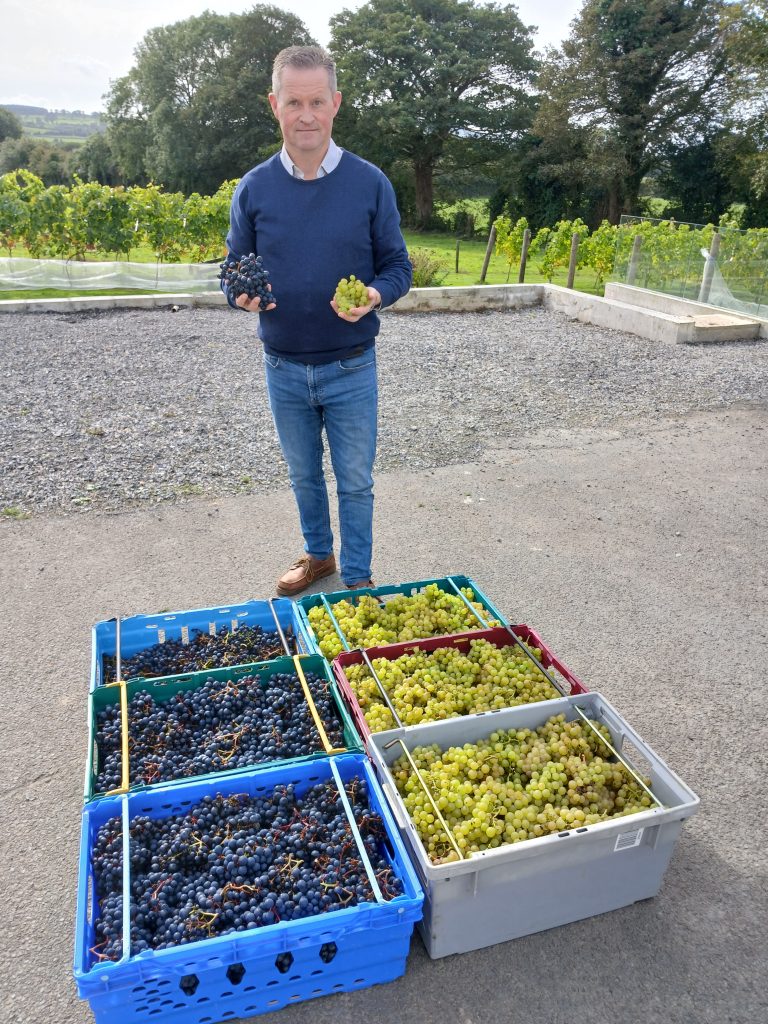
Our 2026 harvest results recorded the quantities produced by four varieties in our pilot plot at Ballystanley. Those results are valuable, but they represent one harvest at one site.
They are the beginning of an evidence base, rather than a final verdict on what will succeed at Ballyclery.
Why one excellent harvest can be misleading
One of the most useful moments in the interview comes when David discusses the 2026 growing season.
He describes it as exceptionally favourable for Irish viticulture. Some varieties he had grown for years ripened successfully for the first time.
That is encouraging, but it also creates a risk: a grower could interpret an exceptional result as normal performance.
A variety that ripens beautifully in a particularly good summer may struggle in a less favourable year. Vineyard planting decisions need to consider that possibility because their consequences last far beyond a single vintage.
For us, the lesson is to enjoy the progress while continuing to measure, compare and learn.
Our accompanying article on Brix, Oechsle and acidity in our 2026 grapes explores some of those measurements. Over time, recording them across different seasons should help us understand our grapes more clearly.
Irish wine can develop its own character
Another misconception David challenges is that Ireland could only produce white wine.
He points to his experience with Rondo as evidence of the potential for Irish red wine. The conversation also explores sparkling wine and the scope to create different styles from the grapes that perform here.
His broader message is that growers should concentrate on making the best wine possible from suitable varieties.
For wine drinkers, that may mean encountering unfamiliar grape names and flavours. Helping people understand those differences is part of the opportunity.
We want visitors and readers to become curious about what Irish vineyards can produce, and to judge the resulting wines on their quality.
What did David think of our first wines?
This was the part of the conversation I was particularly keen to reach.
David helped us process the Seyval Blanc, Phoenix and Rondo grapes from our maiden 2026 harvest. When we recorded the interview in early November, the wines were still young and the Rondo was undergoing malolactic fermentation.
His early assessment was encouraging. He described the white as already pleasant to drink, although unfinished, and was positive about how the Rondo was developing.
He also repeated the qualification that we had benefited from an excellent growing season.
For Nicola and me, that combination of encouragement and perspective is valuable. We are excited about the first results while recognising that the wines still need time and that future seasons will bring different challenges.
Frost and the realities of a new vineyard in Offaly
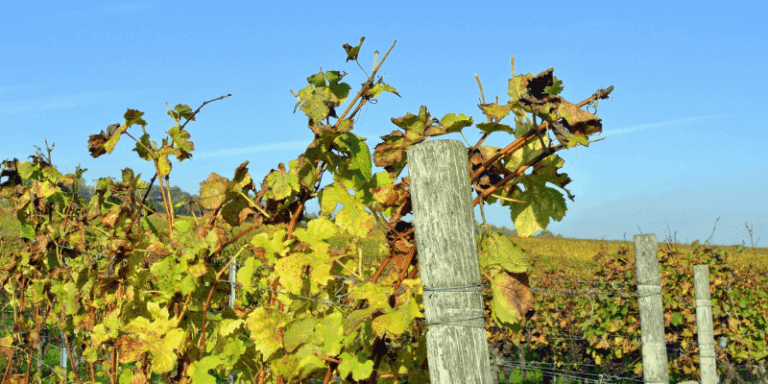
When I asked David about the greatest risk as we work towards 5,600 vines at Ballyclery, he highlighted frost.
Our inland site has a different setting from his vineyard near the east coast. There is no established history of commercial grape production on our farm to tell us precisely how the vines will perform.
David’s concern was the potential for damaging frost and the importance of learning how exposed the site is.
This is already central to our thinking. Establishing a vineyard involves understanding the risks particular to the land and deciding how to manage them as our knowledge improves.
Success means growing, making and selling
Towards the end of the interview, I asked what success for Irish Wine Estates might look like five or ten years from now.
David brought the answer back to a practical sequence: grow a worthwhile crop, ripen the grapes, make good wine and sell it.
Each stage matters. As we discussed, even producing good wine would not create a sustainable business if it could not be sold at a price that covered its costs.
That connects directly with why we are undertaking this project. We want to give our 27-acre family farm a viable future through viticulture, winemaking and visitor experiences.
Land, Food & Future gives us a way to explore that ambition with people who have pursued their own ideas on Irish land. Their experience, including the difficult lessons, can help us ask better questions about our own plans.
David was a fitting first guest: generous with his knowledge, encouraging about the possibilities and clear about the challenges.
Watch the full conversation on YouTube and tell us who you would like to hear from in a future episode.
You can also follow our progress through the Irish Wine Estates Journal.