There is a point in growing grapes when the speculation stops and the weighing scales take over.
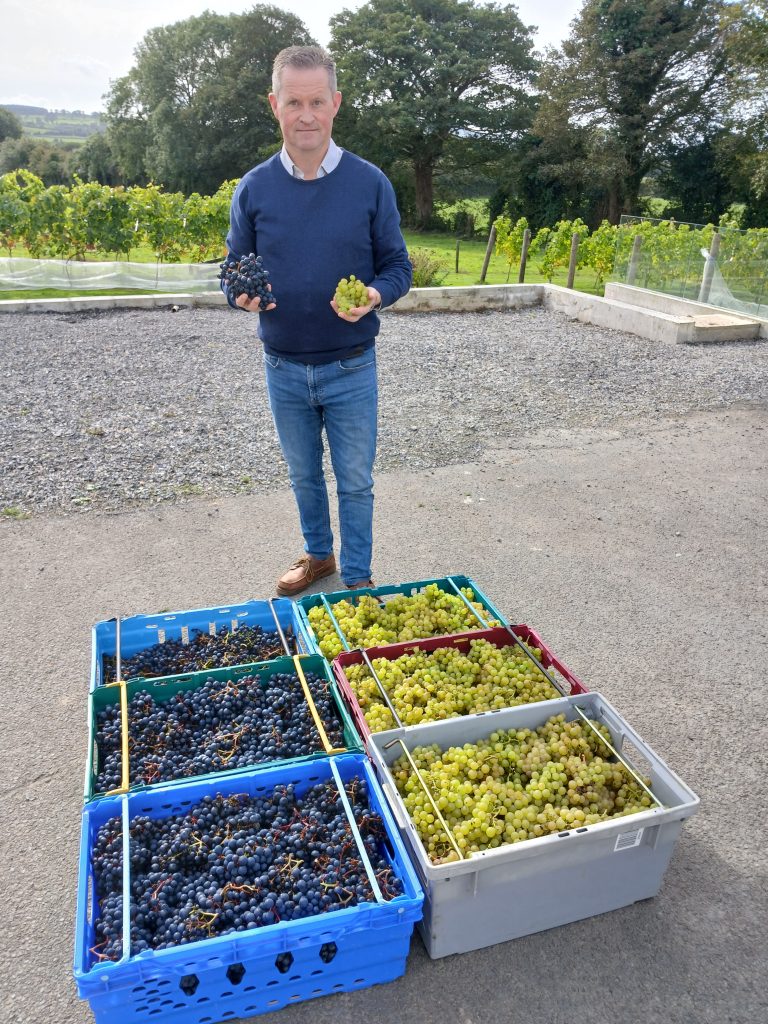
For Irish Wine Estates, our 2026 harvest at Ballystanley produced 118.4 kg of grapes across four varieties: Solaris, Rondo, Phoenix and Seyval Blanc. Our pressing records totalled 73.57 litres, with Phoenix and Seyval Blanc recorded together.
These are modest quantities. But when you are building an Irish wine project, a small harvest can answer useful questions and raise a few more.
Which vines survived? Which produced a worthwhile crop? How far apart were the harvest dates? And what should we take from the results as we develop our larger vineyard at Ballyclery, County Offaly?
Here are the numbers, including the results we would rather have been better.
Our 2026 grape harvest results
This harvest came from Ballystanley, separate from our main vineyard development at Ballyclery. We originally planted 25 vines of each variety: 100 vines in total. By the 2026 harvest, 88 remained.
| Grape variety | Surviving vines | Harvest date | Grapes harvested | Recorded pressed volume |
|---|---|---|---|---|
| Solaris | 25 | 5 September 2026 | 1.2 kg | 0.57 litres |
| Rondo | 24 | 1 October 2026 | 41.0 kg | 31.0 litres |
| Phoenix | 23 | 1 October 2026 | 56.3 kg | 42.0 litres, including Seyval Blanc |
| Seyval Blanc | 16 | 6 October 2026 | 19.9 kg | Included in the Phoenix figure above |
| Total | 88 | 5 September–6 October | 118.4 kg | 73.57 litres |
The 42 litres for Phoenix and Seyval Blanc is a combined figure, counted once. Pressed volumes are also not the same as finished, bottled wine; that is a later stage of the story.
Phoenix delivered the largest crop
Phoenix was the largest contributor to our 2026 harvest, producing 56.3 kg from 23 surviving vines.
That works out at approximately 2.45 kg per surviving vine and almost 48% of the total grape weight harvested across all four varieties.
For a small planting, it was an encouraging result. Phoenix supplied more grapes than any other variety in this trial, both in total and per surviving vine.
That does not automatically make it our best wine grape. Crop weight is only part of the assessment. The wine itself, consistency over several seasons and the work involved in growing the grapes will all matter.
But on the straightforward question of what went into the harvest containers this year, Phoenix led the way.
Rondo produced 41 kg from 24 vines
We harvested Rondo on 1 October, the same day as Phoenix.
With 24 of the original 25 vines surviving, Rondo produced 41 kg of grapes, or approximately 1.71 kg per surviving vine. Its recorded pressed volume was 31 litres.
Alongside Phoenix, it accounted for most of this year’s crop. Together, the two varieties produced 97.3 kg, just over 82% of our total harvest.
Those are useful figures to have as our Irish wine project develops. They give us something concrete to record and compare with future seasons, rather than relying on an impression that a row “looked good”.
They are not, however, a formula we can simply multiply by the number of vines at Ballyclery. A small planting’s performance in one season cannot tell us exactly what a different vineyard will produce.
Seyval Blanc: the missing vines matter too
Seyval Blanc was our final harvest, picked on 6 October.
The 16 surviving vines produced 19.9 kg, approximately 1.24 kg per surviving vine. Its pressed volume is included in the 42 litres recorded with Phoenix.
The more striking number is the survival figure. We planted 25 Seyval Blanc vines, but only 16 remained: nine fewer vines, a loss of 36% of the original planting.
That deserves attention alongside the harvest weight. If we only report the grapes produced by the surviving vines, we leave out an important part of the growing experience.
The figures do not establish why those vines failed. Nor would it be sensible to turn one small planting’s experience into a verdict on Seyval Blanc across Ireland. They do show why we need to record establishment and survival as carefully as the eventual crop.
Solaris: an early harvest, but very little fruit
Solaris was harvested first, on 5 September, almost a month before our October picking.
All 25 vines survived, yet the crop amounted to only 1.2 kg, with 0.57 litres recorded after pressing.
It was the smallest harvest by a considerable margin.
The contrast is useful: complete vine survival did not translate into a substantial crop. These records do not explain the low yield, so we should resist supplying a convenient explanation after the event.
For us, it is a result to investigate and follow over subsequent seasons. It belongs in the harvest report just as much as Phoenix’s stronger performance.
What this harvest tells us about growing grapes in Ireland
Our 2026 results show why we are taking a measured approach to developing Irish Wine Estates.
Four varieties, planted in equal numbers, produced very different outcomes. Harvest dates stretched from early September into October. Survival ranged from all 25 original vines remaining to only 16. Crop weights varied even more.
That is the value of keeping and sharing the records. They help us separate what we hoped might happen from what actually happened.
As we develop our vineyard at Ballyclery, these observations sit alongside our wider work trialling grape varieties for Irish conditions. We need to understand the whole progression from establishing a vine to growing its fruit and assessing the resulting wine.
For now, the 2026 harvest gives us 118.4 kg of evidence and plenty to think about before the next one.
Follow our Irish Wine Estates Journal as we share the harvests, experiments and practical work behind building an Irish vineyard.