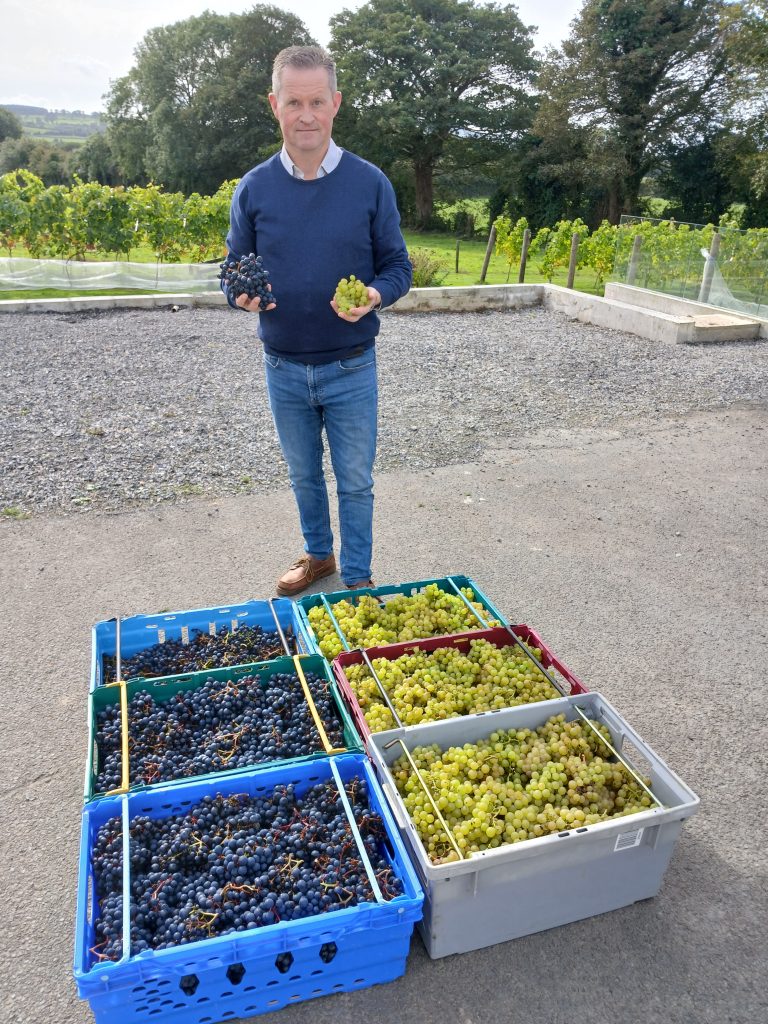
Harvesting grapes brings one set of questions to an end and opens up another.
We now know what our four grape varieties produced at Ballystanley in 2026. But weighing the harvest only tells us part of the story. What was inside those grapes? How much sugar had accumulated? How much acidity remained? And what might those figures mean for the wine?
As newcomers to winemaking, we are learning to read a different kind of harvest report. Alongside kilograms and litres, there are measurements called Brix, Oechsle and acidity.
They can look rather technical. Behind them are questions that anyone who enjoys wine can understand: how strong might it be, how fresh might it taste, and will everything come together in balance?
Our 2026 grape analysis results
These results relate to the harvest from our pilot planting at Ballystanley, separate from our main vineyard at Ballyclery, County Offaly.
| Grape variety | Brix (°Bx) | Oechsle (°Oe) | Recorded acidity (g/L) |
|---|---|---|---|
| Solaris | 20 | 83 | 9.9 |
| Rondo | 21.4 | 89 | 9.8 |
| Phoenix | 16.5 | 67.5 | 9.9 |
| Seyval Blanc | 16.5 | 67.5 | 12.0 |
Rondo recorded the highest sugar reading. Phoenix and Seyval Blanc had identical Brix and Oechsle figures, but different acidity levels.
Already, there is something useful to learn: two grape samples can have the same sugar reading without offering the same starting point for wine.
For the crop weights, harvest dates and surviving vine numbers, see our 2026 Irish wine harvest results.
What does Brix tell us about wine grapes?
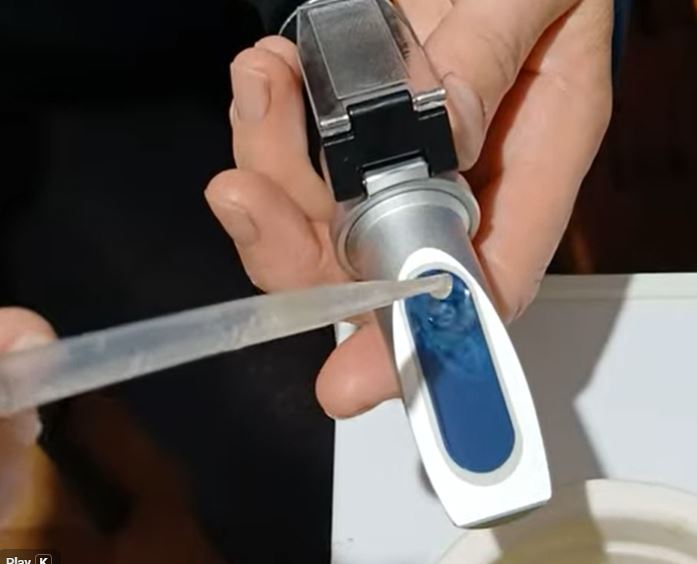
Brix measures the concentration of dissolved solids in a liquid. In grape juice, most of those solids are sugars, so it provides a useful estimate of sugar concentration.
Strictly speaking, a 20° Brix reading corresponds to the concentration of a solution containing 20 grams of sucrose in every 100 grams of solution. Grape juice contains other dissolved substances too, so Brix is not a laboratory measurement of pure sugar alone.
During alcoholic fermentation, yeast converts sugars into alcohol and carbon dioxide. The starting sugar concentration therefore helps a winemaker estimate the potential alcohol in the wine.
However, sugar ripeness and flavour ripeness are not identical. A grape can reach a particular Brix reading without having developed the flavours we want. Tasting the fruit still matters. [1]
Our Rondo measured 21.4° Brix, compared with 16.5° Brix for Phoenix and Seyval Blanc. That points towards greater potential alcohol from Rondo’s natural sugars, assuming comparable fermentation conditions.
It does not tell us that Rondo will necessarily make the best wine.
What is Oechsle, and why record both measurements?
Oechsle, written as °Oe, measures how much denser grape juice is than water. Dissolved sugar increases that density.
For example, 83° Oechsle corresponds to a specific gravity of 1.083: the juice is approximately 8.3% denser than water under the measurement conditions.
Brix and Oechsle are closely related ways of describing the juice’s concentration. They are not two separate ingredients, and we do not add them together. Recording both makes it easier to understand records and discussions that use different scales.
Our Solaris readings of 20° Brix and 83° Oechsle describe broadly the same aspect of the harvest. Neither measurement tells us how acidic the juice is. [2]
Can Brix predict the alcohol in the finished wine?
It can provide an estimate, rather than a promise.
A rough working range is to multiply Brix by 0.55 to 0.60, depending on the assumptions and conversion used. Applied to our results, that gives:
| Grape variety | Approximate potential alcohol from starting sugars |
|---|---|
| Solaris | 11.0–12.0% |
| Rondo | 11.8–12.8% |
| Phoenix | 9.1–9.9% |
| Seyval Blanc | 9.1–9.9% |
These are calculated illustrations, not measured alcohol levels in our wines. They assume fermentation to dryness without enrichment or concentration. Actual results depend on the juice composition and fermentation, while subsequent winemaking decisions can change the final alcohol level. [3]
Higher starting sugar also does not automatically mean a sweeter finished wine. If the yeast ferments the available sugars to dryness, relatively little sugar remains. Sweetness depends on what is left in the finished wine, not simply how sweet the grapes were at harvest.
What does acidity contribute to wine?
Acidity gives wine much of its freshness and mouth-watering character. Think of the lively sensation of biting into an apple.
Too little acidity can leave a wine tasting flat. Too much, relative to its fruit, sweetness and other components, can make it feel sharp or austere.
In wine analysis, acidity reported in grams per litre commonly means titratable acidity, often abbreviated to TA. It measures the acidity neutralised during a standard test and is commonly expressed as tartaric acid equivalents. It does not mean that every gram measured is tartaric acid. [4]
Our recorded figures range from 9.8 g/L for Rondo to 12.0 g/L for Seyval Blanc. Assuming the samples were analysed on the same basis, Seyval Blanc had the highest measured acidity.
Phoenix and Seyval Blanc make a particularly interesting comparison. Both measured 16.5° Brix, but Seyval Blanc recorded 2.1 g/L more acidity. That difference could influence how the wines taste and how a winemaker approaches them.
It cannot tell us exactly how either wine will taste in the glass.
Acidity and pH are different measurements
Another number belongs alongside acidity: pH.
TA helps describe the amount of acidity measured by titration. pH describes how acidic the juice’s chemical environment is. It matters for microbial stability, colour and how effectively sulphur dioxide protects a wine.
The two measurements are related, but they are not interchangeable. Two juices with the same TA can have different pH values.
There are no pH results in the figures presented here, so we cannot use this table alone to judge stability or make detailed decisions about acidity management. [5]
How do these measurements influence winemaking?
The intended wine style helps determine what a winemaker wants from the grapes.
For a still red, sugar concentration needs to be considered alongside acidity, flavour, colour and the maturity of the skins and seeds. Rondo’s higher Brix reading is useful information, but it leaves plenty still to assess.
For a sparkling wine, a relatively modest starting alcohol level and retained acidity can be useful. In traditional-method production, a second fermentation produces the bubbles and adds further alcohol. However, high acidity alone does not make grapes ideal for sparkling wine. Fruit quality, flavour and the eventual balance still matter. [6]
Acidity can also change during winemaking. One example is malolactic fermentation, in which bacteria convert malic acid into lactic acid. This can reduce acidity and change the wine’s flavour and texture. Whether to encourage it depends on the wine and the style being pursued.
That is one possible winemaking decision, not a statement that we have carried it out on these particular batches. [7]
What are we learning about growing grapes for Irish wine?
The clearest lesson is that crop size, sugar concentration and acidity need to be considered together.
Phoenix produced our largest crop, while Rondo recorded the highest Brix. Solaris reached 20° Brix but supplied very little fruit. Seyval Blanc matched Phoenix’s sugar reading while retaining more measured acidity.
Each result adds another piece to our understanding. None provides a complete verdict on a variety after one season.
As our vineyard develops, we want to connect these records with how the wines ferment, mature and eventually taste. That will be more useful than deciding that the biggest crop, highest sugar reading or lowest acidity must be the winner.
For anyone following our journey without a winemaking background, these measurements offer a way into the process. They help explain why growing grapes and making wine involve so many decisions.
We have harvested the fruit. Now we are learning what it can become.
Follow the next stages in the Irish Wine Estates Journal.