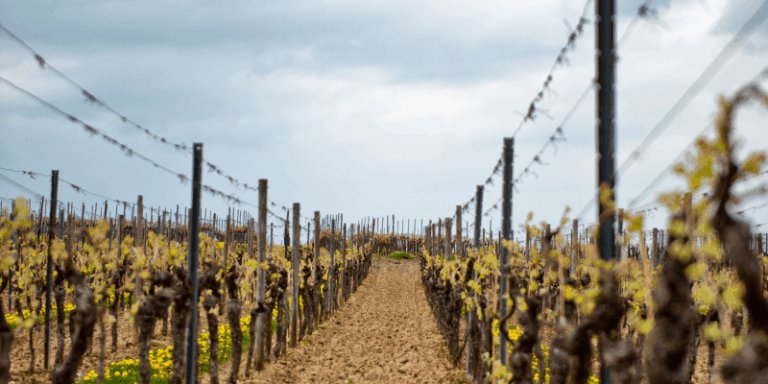
Establishing a vineyard in Ireland involves a fair amount of learning.
Some of that comes from books, consultants and other growers. Some comes simply from walking the vineyard every day and seeing how the vines respond. But increasingly, we also want that learning to be backed by reliable data from the vineyard itself.
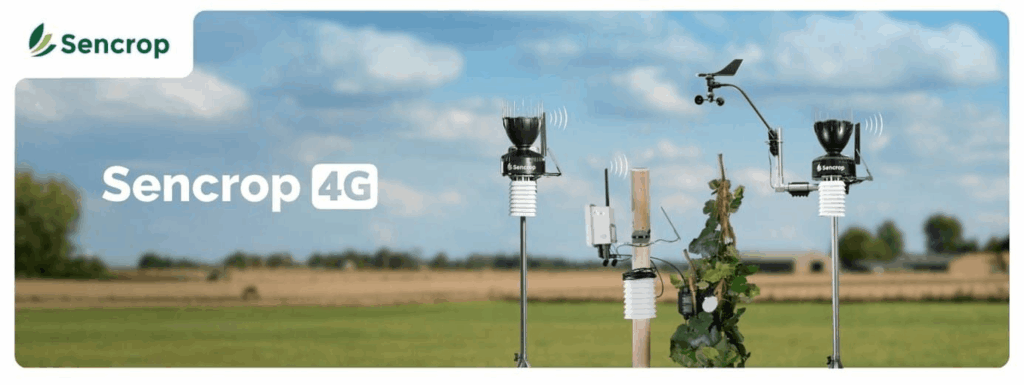
In April 2026, we installed a Sencrop 4G+ weather station at Irish Wine Estates in South Offaly.
It is a relatively small piece of equipment, but we expect the information it collects to become increasingly important as we learn more about our site, our grape varieties and how vines behave in Irish conditions.
You can read more about the vineyard itself on our Our Vineyard page.

Why local weather data matters
Weather obviously matters in every vineyard, but Irish conditions make understanding it particularly important.
Our growing season can include rapid changes in temperature, periods of prolonged rainfall, high humidity, spring frost risk and, as we have already discovered, occasional stretches of unexpectedly dry weather.
General weather forecasts are useful, but they do not necessarily tell us what is happening in one particular field.
A weather station positioned in the vineyard gives us information from the place where the vines are actually growing.
That distinction matters.
Temperature at the vineyard can differ from the nearest town. Rainfall can be highly localised. Wind conditions can vary across relatively short distances. And when you are deciding whether young vines are under stress, whether conditions favour disease or whether it is sensible to carry out a vineyard operation, local information is much more useful than a regional forecast.
What are we measuring?
The Sencrop station allows us to build a continuous record of conditions at the vineyard, including important measures such as:
- temperature;
- rainfall;
- humidity;
- wind conditions;
- accumulated heat through the growing season.
The individual measurement is useful. The longer-term record is potentially much more useful.
Over several seasons, we should begin to understand not simply what the weather was on a particular day, but how one season compares with another and how different grape varieties perform under those conditions.
That is where the real value lies.
Understanding frost risk
Spring frost is an obvious concern when growing vines in Ireland.
Once buds begin to open and tender new growth appears, a sufficiently cold night can cause serious damage.
Having accurate local temperature data makes it easier for us to understand when potentially dangerous conditions are developing rather than relying purely on a forecast covering a much wider area.
It will also allow us to build up a record of which parts of the season present the greatest frost risk at Ballyclery and how frequently those conditions actually occur.
We are still learning our site. The point of collecting the data is not to pretend that we already have all the answers.
Weather, humidity and disease
One of the major challenges of growing grapes in a relatively humid climate is fungal disease.
Diseases such as downy mildew, powdery mildew and botrytis are influenced by a combination of temperature, moisture and humidity.
That does not mean a weather station tells us automatically whether to spray something on a Tuesday afternoon. Viticulture is rather more complicated than giving a sensor command of the vineyard.
What it does provide is better information.
Combined with actually inspecting the vines, weather data can help us understand periods of higher disease pressure and make vineyard interventions more timely and proportionate.
That becomes particularly important as we evaluate disease-resistant and other experimental grape varieties alongside more established varieties.
Our wider approach to these trials is explained on Our Vineyard.
Measuring the heat available to the vines
Another measure we are particularly interested in is Growing Degree Days, or GDD.
Put simply, GDD gives us a way of measuring the amount of useful heat accumulated during the growing season.
That matters because grape varieties differ significantly in the amount of heat they need to ripen successfully.
At Irish Wine Estates we are growing and trialling a wide range of varieties precisely because Irish viticulture is still developing and we do not believe all of the answers have already been established.
Over time, we will be able to compare accumulated heat with things such as:
- budburst;
- flowering;
- fruit set;
- véraison;
- sugar development;
- harvest dates;
- disease performance;
- overall vine growth.
One season will not tell us very much on its own.
Five or ten seasons should tell us considerably more.
From observation to evidence
We are deliberately treating the vineyard as a long-term learning exercise.
Walking the rows remains essential. There is no substitute for looking at vines, leaves, shoots and fruit.
But human observation has limitations. Memories are imperfect and seasons have an irritating habit of feeling more extreme in retrospect than the numbers sometimes show.
Recording weather data gives us an objective reference.
If Solaris performs particularly well in one year and poorly in another, we can look back at the conditions surrounding both seasons.
If one variety consistently ripens earlier, we can relate that to accumulated heat.
If disease pressure appears unusually high, we can examine the rainfall and humidity that preceded it.
Over time, that turns individual observations into something much more useful.
Learning how our vineyard behaves
One of the things we find most interesting about developing Irish Wine Estates is that we are building the vineyard and learning about it at the same time.
The Ballystanley pilot vineyard was planted in 2024 to give us some early practical experience. The much larger Ballyclery planting followed in 2026.
Those two sites, the varieties planted in them and the information we gather each year are gradually helping us understand what works here.
That process of experimentation and adaptation is central to the story of Irish Wine Estates. You can read more about how the project developed on Our Story.
A useful tool, not a crystal ball
There is a temptation with agricultural technology to make it sound as though collecting enough data removes uncertainty.
It doesn’t.
Weather stations cannot control the weather. Models do not replace walking the vines. And no amount of information guarantees that a growing season will cooperate.
The value is simpler than that.
Better information allows us to make better-informed decisions.
Sometimes the right decision will still be to wait.
Sometimes the data will confirm what we already suspected.
And occasionally it will tell us that what we thought we were seeing in the vineyard was not quite what was actually happening.
All three outcomes are useful.
Building a record for the future
The Sencrop station is therefore less about one clever piece of vineyard technology and more about building a record.
Year after year we will accumulate information about the weather, vine development and the performance of different varieties in South Offaly.
We expect that record to become increasingly valuable as the vineyard matures.
And for visitors, it will eventually form part of the story too.
Our 2027 Preview Vineyard Tours will allow small groups to see a working Irish vineyard while it is still being established and to understand some of the decisions, experiments and occasional mistakes involved in building it.
There will be no wine tasting during the 2027 Preview season. The emphasis is firmly on the vineyard, the farm and the journey.
You can find details and join the Preview Tour list on our Vineyard Tours in Ireland page.
Following the experiment
Irish Wine Estates is still at an early stage.
We do not yet know which of our experimental varieties will prove most successful, how individual seasons will compare or exactly what lessons the next few years will produce.
That uncertainty is part of what makes the project interesting.
The weather station simply gives us another way of turning those years of experience into something we can measure, compare and learn from.
And in a vineyard being built almost from scratch in the middle of Ireland, there should be plenty to learn.